







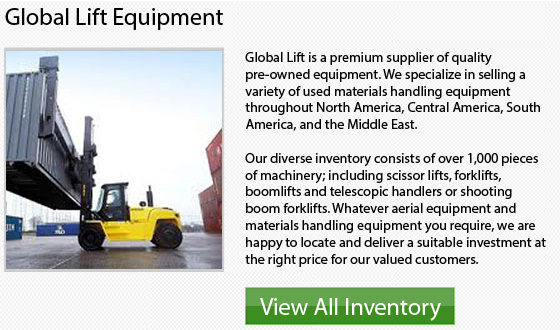
Lift trucks are mobile machines that utilize 2 forks or prongs to be able to place loads into positions that would usually be hard to reach. Usually, forklifts fall into 2 major categories: rough-terrain and industrial.
Most often, industrial forklifts are utilized around truck loading docks and train loading docks as well as in warehouse operations. These machinery have smaller tires which are engineered to run on smooth surfaces. Normally, industrial lift trucks are powered by an internal gasoline engine running on diesel fuel or propane.
There are some smaller industrial lift truck models that use an electric motor running off an internal battery. As the name implies, rough terrain lift trucks are designed to run on rough and unpaved surfaces. Normally, they are the ideal choice for construction and military operation. Rough terrain lift trucks generally have large pneumatic tires that are usually powered by internal industrial engines that run on diesel or propane fuel. These forklift units can have a telescoping boom, that can carry loads up and out from the machine's base or they can utilize a vertical tower, which is responsible for lifting loads straight up.
The rough terrain forklift emerged during 1946, after a 2 pronged lift attachment was attached to a tractor chassis or a power buggy. This initial machinery was utilized around construction locations and can lift to a height of 30 inches or 76 cm and had a lifting capacity can lift 454 kg or 1000 pounds. Vertical tower forklifts were quickly developed for industrial use and rough terrain forklifts became popular as well. By the time the 1950s came around, there were models available which can raise up to heights of 9 meters or 30 feet and had lift capacities of 2500 pounds or 1135 kg.
During the year 1958, the original 4-wheel drive rough terrain lift truck was introduced with a capacity of 6000 lbs. or 2724 kg and had a lift height of 7 meters or 22.5 feet or 1362 kg or 3000 lbs. and 11 meters or 35 feet. The very first telescoping boom rough terrain forklift emerged on the market in the year 1962. This model allowed loads to be placed out from the base of the machinery both above and below grade.