
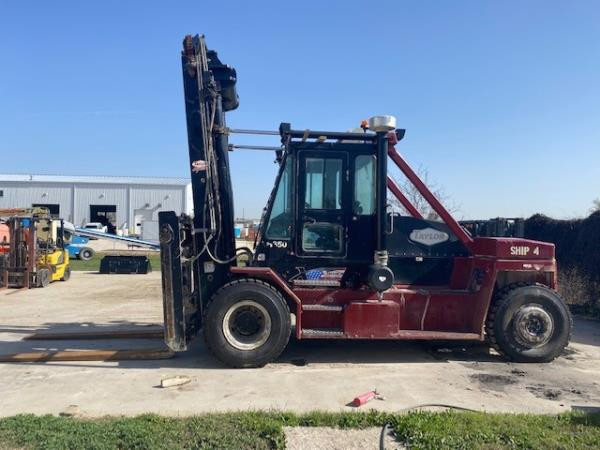

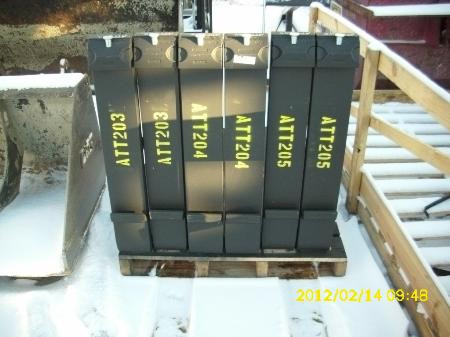
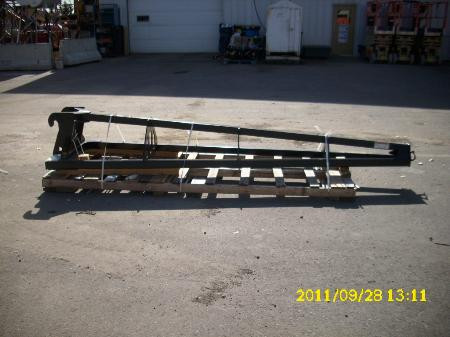

Below are add-ons that are useful for narrow aisle forklifts:
Side shift: Side shift is an option that allows the movement of the load laterally without having to move the unit. This enables loads to be accurately positioned.
Tilt mast: The optional tilt mast enables the forks to shift both forwards and backwards. This is perfect in cases where loads aren't entirely level. To gain greater stability when moving a loaded truck, the mast can be tilted back.
Extendable forks: Extendable forks help the reach of a forklift to allow for the stacking of pallets one in front of the other. This is known as double deep loading.
Operator platforms: Operator platforms allow some NA forklifts to lower and raise the operator whilst the forks are being lowered or raised. This provides optimum control and visibility when dealing with cargo at heights of 6 m to 9 m.
Lift Truck on a Ramp
Forklift drivers should be correctly trained on the machinery. They should be assessed and licensed or certified. It is really vital for anyone operating a lift truck to be really knowledgeable about safety problems and regulations. Drivers should know how to adjust in situations where the weight of the load alters the center of gravity or on uneven surfaces. Safety measures include the safe use of a lift truck on a ramp, which is a frequent occurrence as the operator would typically have to drive up and down ramps to be able to unload and load containers.
Guidelines for Using a Forklift on a Ramp
1 When approaching and driving up and down the ramp, drive slowly. The possibility of accidents is increased while driving at high speeds because this could upset the machine's center of gravity.
2 Drive the lift truck in reverse while moving up an incline on a ramp while not carrying a load.
3 Drive forward while moving down an incline on the ramp with no load.
4 Tilt the forks a little back to shift the center of the load to the equipment's front, when moving up or down a ramp when carrying a load.
5 To make the load more steady, drive forward up a ramp when carrying a load.